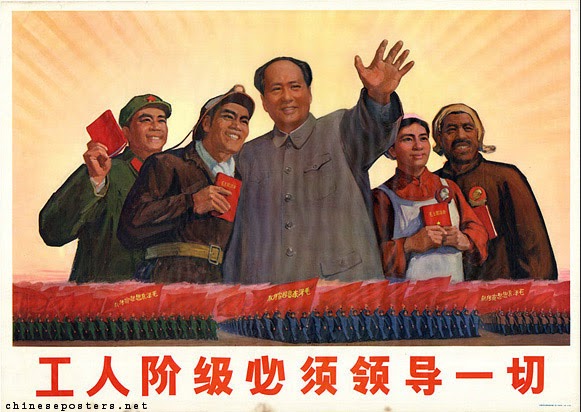
At the time the new and united nation of “The People’s Republic of China” under Chairman Mao would be marked by rapid changes and grandiose projects that would be pushed by strong idealism. The sense of togetherness and unity that was being projected by the government during this period of time was essential to spread and generate acceptance for government endeavors. The label for this Fuzhuan tea “People’s Unification Tea” represents one of many avenues that would be used by the government to communicate and impact social change and people’s thinking through propaganda.- Note the similar style and design of the tea label to the propaganda posters under Chairman Mao's Era here and here.
Tuesday, February 24, 2015
1970s Fuzhuan Brick (People’s Unification Tea)
Under the reign of Chairman Mao Zedong and the Communist Party private ownership of tea factories became illegal. This hefty 1970s Fuzhuan tea (aka Fu brick tea) from Sichuan Province, Guanxi weighing 3kg represents a united co-operative of the people under a socialist economy. The socialist approach is based on production for use and to satisfy the basic demands and needs of the people for all the people. Unlike capitalism the basis of production is not for profit and therefore not to cater for special groups of consumers with the wealth to make purchases in order to accumulate capital. This tea is symbolic of the belief and idealism at the time and was produced by the people and for the people under the management of the Chinese government.
Tuesday, February 17, 2015
1950s Liu An Sun Yishun
The story of Liu An tea is not well known. For this reason the amazing quality of older Liu An vintages have largely gone unnoticed until recently. The pre1950s era remains the pinnacle for Liu An appreciation when this little basket of tea leaves weighing approx. 600g was enjoyed by the Chinese upper class and considered amongst the top teas in China.
This early 1950s Liu An Sun Yishun represents the last batches of Liu An tea from an old era that was almost permanently erased from history under the reforms of Communism. This tea is symbolic of the wealth, refinery and pursuit for excellence that the upper class in China enjoyed under the Nationalist Government and capitalism. The production of Liu An tea during this time period was catered mainly to the wealthy and as a result the quality of the tea was made to a very high standard. This resulted in a highly meticulous and labor intensive production that is evident today in the quality and elegance of the brew and the astonishing uniformity of the leaves in shape and size that are compressed in these baskets.
Friday, February 13, 2015
The Reign of Chairman Mao Zedong (1949-1976) - Part2/2
20th Century Chinese History - Article 2 >> go to Main Page
3) The Cultural Revolution (1966-76)
Culture must serve workers, peasants and soldiers, must serve proletarian politics
Tuesday, February 10, 2015
The Reign of Chairman Mao Zedong (1949-1976) - Part1/2
20th Century Chinese History - Article 2 >> go to Main Page
Chairman Mao Zedong aka Freedom Fighter, Great Leader, Visionary, Hero, Legend, God. Whilst all this is true the period that Chairman Mao reigned from 1949 to 1976 as the undisputed leader of China was a time of immense upheaval, turmoil, great suffering and an unprecedented loss of lives. The reign of Chairman Mao will perpetually be remembered under three key events; 1) Class Warfare, 2) The Great Leap Forward and the Great Famine, 3) The Cultural Revolution and this is where we will focus our attention.
1) Class Warfare (Early 1950s)
Chairman Mao Zedong aka Freedom Fighter, Great Leader, Visionary, Hero, Legend, God. Whilst all this is true the period that Chairman Mao reigned from 1949 to 1976 as the undisputed leader of China was a time of immense upheaval, turmoil, great suffering and an unprecedented loss of lives. The reign of Chairman Mao will perpetually be remembered under three key events; 1) Class Warfare, 2) The Great Leap Forward and the Great Famine, 3) The Cultural Revolution and this is where we will focus our attention.
1) Class Warfare (Early 1950s)
The working class must rule everything
Friday, February 6, 2015
The Chinese Civil War (1927-1949)
20th Century Chinese History - Article 1 >> go to Main Page
The year 1927 was the start of the Chinese Civil War between the Nationalists Kuomintang (KMT) and the Communist Party of China (CPC). Each political party had different ideologies on which to govern the country but the two that most stood out were capitalism and communism as each party represented a different class of society. Early in the war the Kuomintang under Chiang Kai-shek was expected to crush the People's Liberation Army (PLA) under the Communist Party. At the time the Nationalists were the legal government of China and held superior advantages in numbers and resources with foreign aid coming from America. However plagued by bureaucratic inefficiency and corruption the war dragged on for decades and was interrupted by the Japanese invasion during World War II before resuming.
Tuesday, February 3, 2015
Chairman Mao & The Communist Party - A History Recorded by 2 Teas
i) Sailing the seas depends on the helmsman, waging revolution depends on Mao Zedong, ii) 1970s Fu Brick, People’s Unification Tea from the time of Chairman Mao’s Cultural Revolution, iii) 1950s Liu An Sun Yishun
A part of the allure of old teas is the period of time and history that they represent. Each tea has a story to tell and the 2 old teas that I will be reviewing this month are no different. Both teas come from a time of immense upheaval and unrest that coincides with the rise of Chairman Mao Zedong and the rule of the Communist Party of China. The contrasting qualities of the 2 old teas in many ways mirror the two prominent political parties (Kuomintang, KMT and Communist Party of China, CPC) at the time. The turn of events would cause each to take two very different paths.
Friday, January 30, 2015
The Tea Market Series (In China) – Article 3 Part 2/2
The Misrepresentation of Age in Puerh Tea - Old Tricks Become More Refined
The misrepresentation of age for puerh tea is a common occurrence. It is a scam initiated by dishonest merchants and spread by those who are unawares. The lack of information and labeling on older teas (especially individual teacakes) from pre 2005 productions makes it difficult for consumers to easily identify the real age of tea. All too frequently merchants are happy to come in and make up those numbers to their advantage by inflating the age of the tea.
During the first wave of the puerh boom in the early 2000s many inexperienced and naïve Chinese buyers came on to the scene. The Chinese people were attracted by the national euphoria that surrounded puerh tea. Puerh was widely promoted as a national heritage and often presented with connotations as being the best Chinese tea. Many people who had previously no interest in puerh tea became caught up in the hype and bought blindly. There was such little knowledge on the part of buyers that dishonest merchants could blatantly pass off a newly produced ripe puerh tea as a precious 30 year old aged raw tea. This simple scam worked amazingly well for a number of years such was the lack of knowledge amongst new buyers during those early years.
Labels:
china,
puerh tea,
tea market,
tips
Subscribe to:
Posts (Atom)